Frequently Asked Questions
Here you’ll find answers to some of the questions we are most often asked about draghunting with the Berks and Bucks Draghounds.
If you are still unsure about anything, please contact our Hon Secretaries. They are always happy to help, particularly if you are joining us for the first time.
Before coming out with us, please make sure you have carefully read and understood our Code of Conduct.
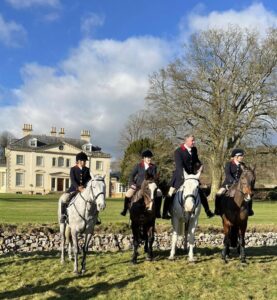
Victoria Ruffy MDH, Amy van Oostrum, Andrew van Oostrum, MDH and Kate Honey, Field Master at the Meet at Rockley Manor
Our main meets usually begin at 12.00pm. Please arrive at the meet location no later than 11.50am, giving yourself plenty of time to park, unload, tack up and be mounted and ready before we move off.
At a lawn meet, drinks may be offered by our hosts before the day begins. Before moving off, one of the Masters will welcome everyone and explain anything you need to know about the country, the planned lines and any other important information for the day.
You should make sure you know who the Field Master is. The Field Master leads the mounted followers, known collectively as the Field, and you should never pass them unless specifically invited to do so.
The Huntsman will then move off with the hounds. When the hounds pick up the laid scent and begin to run, the Field follows across the country, with opportunities to jump fences along the way.
A typical day consists of three or four separate lines, often around 1½ to 2 miles each. There will usually be a break between lines to allow horses and riders to recover, catch their breath and regroup.
You do not have to complete every line. If you feel your horse has done enough, or you would simply prefer to sit one out, please do. Looking after your horse should always come first.
At the end of the day, there may also be tea or refreshments back at the meet.
Please wait until the Huntsman has safely put the hounds away before dismounting and heading back to your horsebox or trailer. If you need to leave before the end of the day, please find a Master and let them know.
And one little tradition to know: when leaving, the customary farewell is “Goodnight Master”, regardless of the time of day.
What sort of horse do I need?
All sorts of horses and ponies come draghunting with us. You certainly do not need the fastest horse in the Field.
For some of our bigger days, however, your horse should be fit, confident across country and, if you intend to follow the jumping route, capable of comfortably jumping fences of around 2’9″ or more.
Most importantly, you should ride a horse you feel safe and confident on.
Our meets vary considerably in terms of terrain, pace and the size or number of fences. We will always try to give an indication on the Meet Card and through our social media as to which days are particularly suitable for newcomers, novice horses or less experienced riders.
Wherever possible, fences are optional and easier alternatives are provided. It is entirely possible to enjoy a wonderful day with us without jumping everything, or sometimes without jumping at all.
Your horse should be suitably fit for the work you are asking it to do.
If your horse is young or inexperienced, please put a green ribbon in its tail so that other riders know to give you a little extra space.
If your horse may kick, it MUST wear a red ribbon. You should also ride in an appropriate position in the Field and take responsibility for keeping your horse a safe distance from others. A red ribbon is a warning to other riders, not a substitute for managing your horse safely.
If a horse is behaving in a way that presents a danger to others, you may be asked to leave the Field.
If you are unsure whether a particular meet is suitable for you or your horse, please contact the Hon Secretariesbeforehand. We would much rather you ask.
What do I wear?
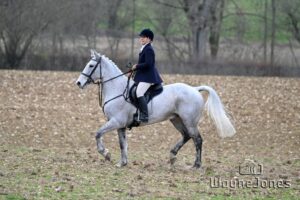
A great example of expected smart turnout levels from the Field from Victoria Ruffy MDH
Draghunting has wonderful traditions around turnout, but if you are new, please do not let worrying about having every item exactly right put you off joining us.
The most important things are that you are safe, smart and comfortable.
Before the Opening Meet, traditional turnout is usually:
- Tweed or ratcatcher coat or jacket
- Shirt and tie
- Fawn breeches or jodhpurs
- Brown or black riding boots
After the Opening Meet, traditional main-season turnout is usually:
- Black or navy coat or jacket
- White or cream stock
- Fawn breeches or jodhpurs
- Black riding boots
Tweed or ratcatcher is also perfectly acceptable throughout the season, and some meets are specifically designated as ratcatcher days.
If you do not yet own all the traditional clothing, please wear the smartest and safest riding clothes you have. We would far rather welcome a well-presented newcomer than have someone stay at home because they are worried about owning the correct coat.
Masters traditionally wear navy coats with red collars and four gold buttons, while Hunt Staff wear five buttons. Members of the Field who have been awarded their draghunt buttons may wear red collars with black buttons. They are generally experienced members of the hunt and are often very good people to ask if you need help or advice.
A great example of smart turnout in the Field from Victoria Ruffy MDH
Safety is more important than tradition.
You should always wear an appropriately fitted riding hat meeting current safety standards. A plain black or navy hat cover looks smartest with traditional hunting dress.
Body protectors are strongly recommended, particularly for children, less experienced riders and anyone intending to jump.
Long hair should be neat and securely tied back, traditionally in a hairnet or bun.
What should my horse wear?
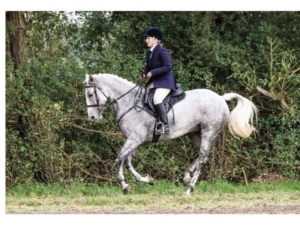
Victoria Ruffy MDH on Delta
Your horse should wear well-fitting, safe and appropriately maintained tack.
Plain, good-quality leather tack is traditional, usually with a general-purpose or jumping saddle.
A comfortable, breathable saddlecloth or numnah in a discreet colour such as black, brown or white matching your horse’s coat is ideal, particularly as your horse may be working for several hours.
Horses are traditionally plaited after the Opening Meet unless the Meet Card says otherwise. On ratcatcher days, plaiting is not usually required.
You may find that your horse needs slightly more control than when schooling at home. Whatever bit or equipment you choose must, however, be suitable for your horse and something both horse and rider are accustomed to using. You should be able to stop, turn and control your horse safely, particularly when the Field checks or changes direction.
A breastplate can be useful for keeping the saddle secure when riding across country and many riders if not in a martingale or breastplate will certainly have a neck strap!
Any boots or protective equipment worn by your horse should fit correctly and be appropriate for the conditions. Bear in mind that mud and water can sometimes cause poorly fitting boots to move or rub.
Traditional draghunting turnout is deliberately understated. Plain saddlecloths, browbands and tack are correct over bright colours, glitter or highly decorative competition equipment.
Above all, your horse should arrive clean, well groomed and smartly turned out, with clean, safe tack.
This is not simply about appearance. Turning out horse and rider properly is a mark of respect to the farmers and landowners who generously allow us to cross their country, and keeping tack clean and well maintained is also an important part of safety.
If your horse is likely to grow a heavy winter coat and will be working regularly through the season, clipping may also be appropriate for its comfort and welfare.
Do I have to jump?
No.
We love our jumping and are fortunate to have some fantastic fences across our country, but you should never jump something you do not feel confident tackling.
Wherever possible, we provide an easier alternative around fences.
Different meets offer very different days, so if jumping is not your thing, or you and your horse are just starting out, speak to our Hon Secretaries. They can recommend the most suitable meets.
There is absolutely no shame in taking an alternative. A good day’s draghunting is about enjoying your horse and the countryside, not jumping the biggest fence.
Is draghunting suitable for children and newcomers?
Absolutely, and we love welcoming new people.
We run Newcomer Meets and Lead Rein Meets specifically designed to provide a gentler introduction to draghunting.
Some of our regular meets are also particularly suitable for children, novice riders or inexperienced horses.
If you have never draghunted before, or you are bringing a child for the first time, please contact our Hon Secretariesbefore booking. They can explain what to expect and help you choose the right day.
Children under 12 must be accompanied by an adult riding with them unless prior permission has been given by the Masters.
Please see our Code of Conduct for full details regarding children, supervision and safety.
How much does it cost?
We offer several flexible ways to join us, from paying a Day Cap for an individual meet through to taking out a full season Subscription if you plan to come out regularly.
Please visit our Caps and Subscriptions page for current prices and full details.
If you are unsure which option would suit you best, please contact the Hon Secretaries.
Anything else I should know?
Be friendly, be considerate and don’t be frightened to ask.
Draghunting has lots of wonderful traditions and a language all of its own, and nobody expects a newcomer to know everything on their first day.
Introduce yourself to a Master or one of the Hon Secretaries when you arrive, listen to the briefing before moving off and ask if there is anything you are unsure about.
Experienced members of the Field will usually be only too happy to help.
Above all, look after your horse, respect our hounds, our Hunt Staff, our farmers and landowners, and enjoy yourself.
Our Association
The Berks and Bucks Draghounds are proud members of the Masters of Draghounds and Bloodhounds Association (MDBA).
We are not associated or affiliated with the British Hound Sports Association (BHSA).